Climate change, air pollution, and rising energy costs have become global issues that can no longer be ignored. Nearly every nation is searching for cleaner, more sustainable alternatives — and renewable energy stands out as the answer.
With its abundant natural resources, Indonesia holds a special position in this global energy transition. The opportunity to shift toward cleaner, more efficient, and self-sufficient energy is wide open, with solar energy emerging as one of the most promising solutions.
Overview of Indonesia’s Current Energy Landscape
Indonesia’s dependence on coal-fired power plants remains high, accounting for around 60–70 percent of total electricity generation. This reliance not only makes the country vulnerable to global price fluctuations but also worsens air quality and directly impacts public health.
Meanwhile, other countries have proven that rapid transformation is possible. Vietnam has quickly increased its solar power capacity, and Germany has managed to meet almost all its electricity needs from wind and solar at certain periods. These examples demonstrate that Indonesia also has the potential to achieve similar progress.
Abundant Renewable Energy Reserves
The government has set a target of achieving a 23 percent renewable energy mix by 2025, in line with the Electricity Supply Business Plan (RUPTL). Data from the Ministry of Energy and Mineral Resources (ESDM) shows that Indonesia’s technical renewable energy potential reaches 3,686 Gigawatts (GW) — far exceeding the country’s current installed capacity.
Here’s the breakdown:
- Solar Energy: 3,294 GW — the mainstay, thanks to year-round sunlight exposure.
- Wind Energy: 155 GW in coastal and highland regions.
- Hydropower: 95 GW from thousands of rivers across the archipelago.
- Geothermal Energy: 23 GW, representing around 40 percent of the world’s total reserves.
- Bioenergy and Ocean Currents: over 119 GW.
Challenges in Renewable Energy Utilization
Despite its vast potential, integrating renewable energy poses technical challenges. Sources like solar power fall under Variable Renewable Energy (VRE), meaning production fluctuates depending on sunlight intensity.
During cloudy or overcast conditions, electricity generation can drop suddenly, creating challenges for maintaining a stable balance between supply and demand.
To address these challenges, several global solutions are being implemented and gradually adopted in Indonesia, including:
- Battery Energy Storage Systems (BESS): store surplus energy for use when production drops.
- Smart Grids: intelligent power networks equipped with sensors and automated controls to maintain real-time supply stability.
Solar Energy: The Cornerstone of the Energy Transition
Among all renewable energy sources, solar power takes the lead. More than 85 percent of Indonesia’s renewable energy potential comes from the sun — equivalent to around 3,294 GW.
Why is solar energy so promising?
- Abundant availability: Indonesia receives an average solar radiation of 4.8 kWh/m² per day.
- Installation flexibility: can be deployed on rooftops (rooftop PV), on open land (solar farms), or on water surfaces (floating solar).
- Decreasing costs: installation prices have dropped by more than 80 percent in the past decade.
These combined factors make solar power the main driver of Indonesia’s energy transition — from households to large-scale national projects.
Trends in the Solar Industry’s Growth
Although still in its early stages, the installed capacity of Solar Power Plants (PLTS) in Indonesia continues to grow. By the end of 2024, total capacity reached 717 Megawatts (MW).
Some notable achievements include:
- Cirata Floating Solar Power Plant in West Java, with a capacity of 192 MWp, the largest floating solar project in Southeast Asia.
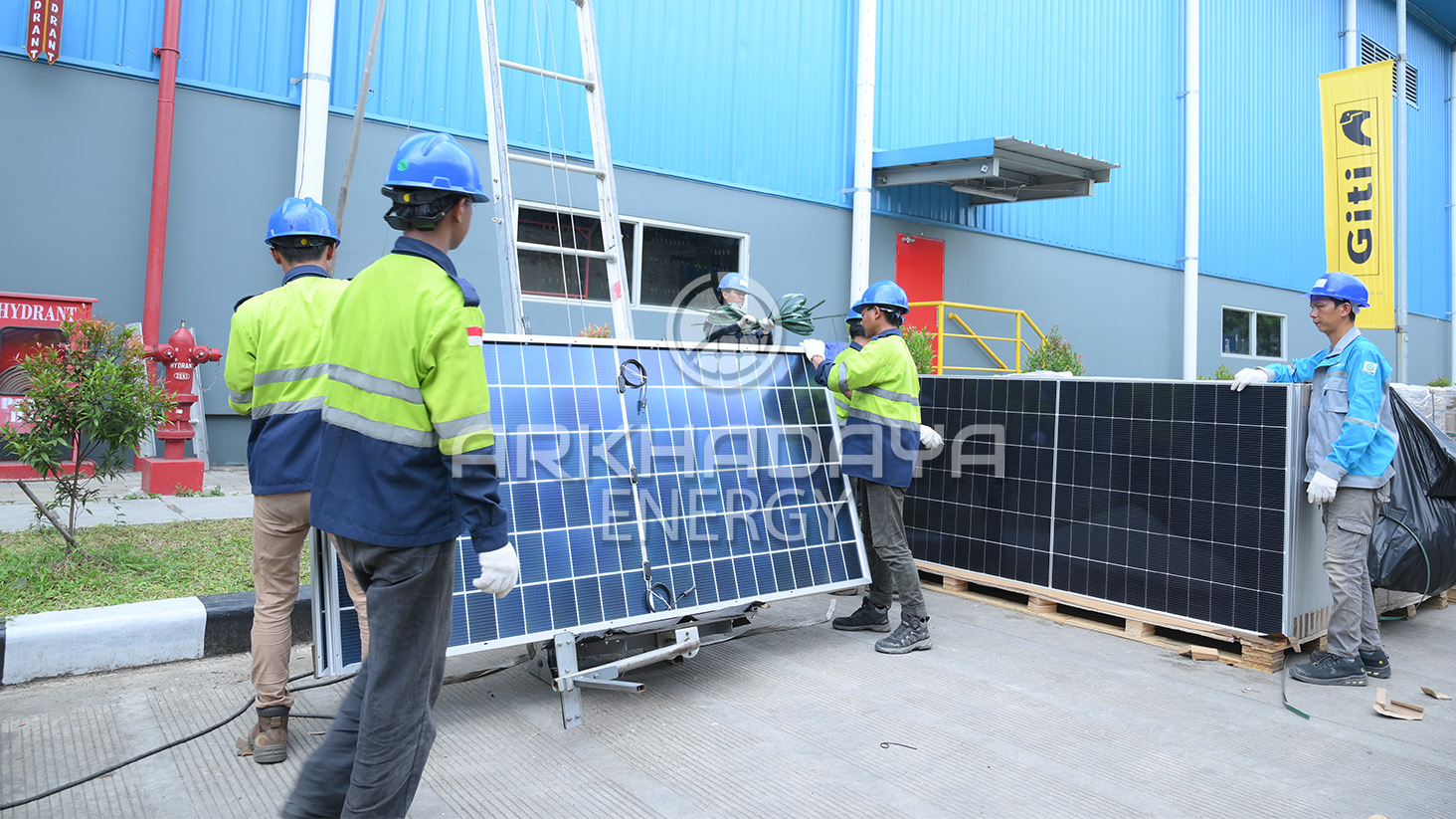
- Private sector adoption of rooftop solar across industrial zones, shopping centers, and manufacturing facilities.
Furthermore, the 2025–2034 RUPTL designates solar energy as the backbone of future power capacity growth.
Bridging Potential and Utilization
Despite its massive potential, Indonesia’s current solar energy utilization stands at only around 0.023 percent. Bridging this gap requires concrete steps, such as:
- Advancing solar panel and battery technology for higher efficiency.
- Fostering cross-sector collaboration among government, PLN, private sector, academia, and communities.
- Raising public awareness of rooftop solar as an independent and sustainable energy solution.
The ultimate vision is to achieve energy independence free from environmentally harmful sources and to create a greener energy future.
Conclusion
Indonesia stands at the dawn of a clean energy revolution. With the right policies, technological advancements, and vast solar potential, the transformation toward a sustainable energy future is becoming more tangible.
As part of Syntek Group, Arkhadaya is ready to be a trusted partner in delivering innovative and sustainable renewable energy solutions — helping realize an energy-independent and environmentally friendly Indonesia.